Pages

Showing posts with label Italy. Show all posts

Saturday, 10 September 2011

Only mad dogs and Englishmen. . .

06/09/2011

This post is not food-focused, as temperatures have been the focus this last month. For produce market pics, though, please go to rowanbishopfoodwriter's Facebook page. . .

Prato has been hot and quiet over August, as locals generally head for the coast in pursuit of the darkest tans possible and the odd sea breeze.  The temperatures climbed sreadily from low 30's to high 30's with no wind or rain at all. Despite this, I made it to Siena (home of panforte, among other things) with friends, and Lucca. We've also visited the town of Vinci (as in Leonardo da), a lovely little town set in an archetypal Tuscan  landscape.

The town of Vinci


The town has a museum dedicated to Leonardo, and has models of some of the things he conceptualised - from cranes to textile looms, to a helicopter, just to mention a few. Of course he managed to also paint the Mona Lisa in his spare time, plus other famous paintings and sculptures, and 'dabble' in anatomy, physics and writing - so many gifts, so productive in so little time - he died at 67.

By the time the mercury hit 40 C, Prato was almost emptied out. It was low humidity, but stepping out the door was like stepping into the blast of an open furnace door for a couple of weeks. The locals who did remain in town came out in the early evenings for a gelato, often, or to sit around one of the fountains or at an open air bar, hoping for a whiff of breeze; the heat was relentless, day and night. Icecreams and sorbets here are very good, and of course very popular.


But back to the heat. . .at least, you'd be forgiven for thinking, I'd be let off the early morning hill walks, but no! . . . I grizzled quite a bit, and pleaded Irish- ancestry- therefore -intolerance- to temperatures -above -35 C, but it all fell on deaf ears.

We did go into Florence several times - to the Uffizi, which is of course air conditioned as well as a must see, and to the Pitti Palace and to walk around the Boboli gardens; the latter, however, turned out to be a mistake in the heat; apparently my face assumed the colour of an over- ripe tomato before we were even half way around.

A suggestive cherub outside the Uffizi

Florence is a magical city, I just love it. I've waited a long time to see the David, but it is worth any wait - it quite literally takes your breath away. Every last tuesday of the summer months, there is free access to all museums and galleries in Florence, from 7pm - 11pm, so last tuesday night we took advantage of this and went to the Bargello, which is magnificent, then 'popped in' to see the David again on our way back to the station. As for the Uffizi, you could spend days in there. Then there's the Duomo of course, and the Ponte Vecchio; this city is stuffed full of history and treasures. To walk around a corner and see the Duomo in front of you - well, I've spent quite a bit of time in Firenze now, most of it with my mouth open.

This week, Prato is a different city; bustling with tanned locals home from their holidays, and 'invisible' doors have appeared all along the narrow streets, opening into lovely shops. The temperatures have dropped to early 30's again and early mornings and the evenings make it a joy to be out.

We did retreat to the coast ourselves for two weekends, to breathe some sea air and swim, and go to the Puccini festival at Torre del Lago - Madame Butterfly, and then back again to see La Boheme. Torre del Lago is a stunning outdoor setting; the lake can be seen from wherever you sit, the stage set in front of it, creating the illusion that the stage is surrounded by the lake.

From one of the exits at Torre del Lago - almost dark

You aren't allowed to take photos of the production or stage, unfortunately, but there's some good photos on the Puccini Festival 2011 website.  Both productions were magnificent but La Boheme was absolutely stunning on all counts, I'd go again tomorrow if I could.

We stayed at Viareggio, on the coast about 8 km from Torre del Lago, and of course wanted to dip our sweaty bods in the sea, but we New Zealanders are so naive (speaking for myself, at least) - it costs a minimum of 15 Euros (about $30.00) to hire 2 deck chairs and a sun umbrella, in order that you use them and a metre of  beach for the day. Loungers cost more. We bit the bullet, more than once.
Italians literally toast themselves, I've never seen so many deeply tanned people in my life, lying in the sun for hours and hours on end, worshipping those rays.


That was a bit of a culture shock, but it was rather lovely to laze around and swim beneath the Carrara mountains (which look snow covered but are in fact the source of the famous carrara marble).


After La Boheme we left Vioreggio and took a boat trip up the Cinque Terre, as we'll be walking it this weekend, with friends Anne and Terry. The five villages are fascinating, clinging to spiny ridges and nestled into clefts in the cliffs - very picturesque, and it was good to see them from the sea and get some idea of what we're in for. After all the hill training I've been doing, though, it should be a doddle.

As for the kitchen, I've been trialling a green gazpacho containing peas, mint or basil and yoghurt, pureed up with my kitchen whizz/wand of course. I decided it would be nice to have something different from the more traditional tomato based gazpacho, and it seems to me that a gazpacho  is essentially raw ingredients either chopped small and combined, pureed or partially pureed - a 'liquid salad', I've heard it called. It's always served chilled, so is ideal for this weather. I've also been trialling a light, fresh lasagne made mostly of raw ingredients. The idea of this is that the vegetables should generate enough liquid for the pasta to cook, but that the dish retains it's fresh flavours. In any case, I continue to scope out the Monday morning market, making sure I go along early so I'm not lugging my puchases home in the heat...more photos of the markets on rowanbishopfoodwriter Facebook pages - click here

Salted anchovies


Wednesday, 24 August 2011

Culinary Conversations from Tuscany

Tomorrow we'll have been in Prato a month, amazingly - the time has gone so fast. We've had some visitors and settled into routines - and of course done some sight seeing. Just to introduce Prato, here is the scene from our third floor bedroom window. . .


And this is a view of Prato from the hills above the town. . .


And this is a view of Russ's back, on one of the tracks above the town, among the olive and fig trees, and grapes. It's a very familiar view to me (his back, that is. . .)


The old part of town, where we live, is surrounded by a medieval wall.


And of course we've made good use of the walkways and cycle tracks all along the river and up into the hills.

Prato just happens to be the center of the slow food movement, with all that conjures in terms of philosophy – using fresh seasonal produce, and as little processed food as possible. Every day I see locals gathering blackberries, stone fruits and crab apples, picking their figs, tending their olives, and I’m able to gather herbs like rosemary, dill, parsley and fennel from the walkways along the river. Of course I include myself as a local now, at least for the next couple of months.

It’s out the door by 7am at the moment if we want to get any exercise, as by 9am it’s simply getting too hot - 40 C now in the middle of the day, though hopefully next month it will cool down a bit. The Monday morning market, however, is not to be missed; apart from mouth watering produce, there’s every chance you’ll be sung an aria while you’re selecting your parmigiana or your pecorino! Some of the stall holders treat the markets as their source of entertainment as well as income, it seems, and love an audience -  a raison d’etre that makes perfect sense to me.

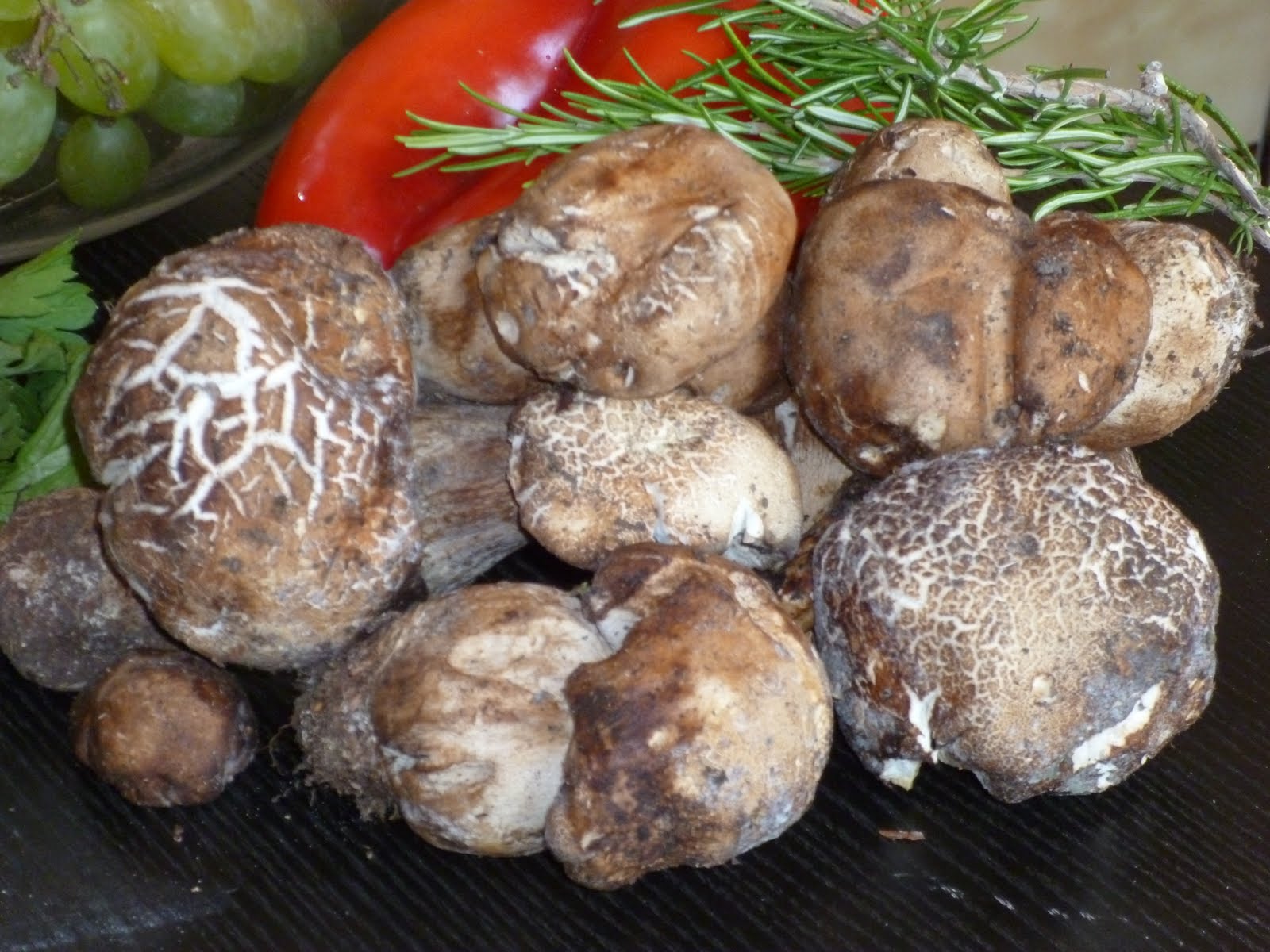
One of the real treats at this time of year is fresh porcini (piglet) mushrooms, plucked straight from the forest; mostly chestnut forests, but occasionally pine - truly, they are to die for, sliced and sautéed in olive oil, a little butter, garlic, salt, pepper, chopped flat leaf parsley, with and without a little mozzarella and gorgonzola melted in to finish them off. Toss them into pasta such as rotelle (wagon wheel) pasta and prepare to be transported. So simple, but so full of flavour. Rotelle catches all the sauce bits in its ‘spokes’ and is ideal for almost any chunky pasta sauce, incidentally.


Fresh porcini - the King of mushrooms

The guy on the left has a great voice. . as well as very good pecorino!

Layered mozzarella and gorgonzola is common in both France and Italy, and is ideal for adding a little creaminess with flavour but not too much ‘bite’ to many dishes – I’ve found it really useful, although sour cream and a creamy blue cheese could be substituted (not lite sour cream, as this can split when heated).

Peaches and nectarines are larger than those back home, but at the risk of banging on about this, we’ve yet to have any rot before they ripen. Don’t get me wrong, the quality of New Zealand stone fruit is just as good, but too often we’ve experienced rotting from the core out, before the fruit ripens, and I’m well aware that we’re not lone voices in this. I’m not bagging New Zealand producers; our produce, overall, is wonderful, and I’m certainly not saying this is endemic – but I’m genuinely bemused and disappointed by how often we and others have experienced this, and believe ripening is an issue that needs to be looked at seriously.

Florence fennel is another star of markets here – I love it thinly sliced and marinated as the base for a salad, but the other day I sautéed a large bulb (about 400g) in olive oil and garlic – slowly, until the fennel was well softened. I’m sometimes put off sautéed and roasted fennel because it turns a rather pallid grey colour, but I tossed in 300g of one of the delicious seafood* mixes available here at the end, just to cook through, then stirred in a spoonful or two of layered mozzarella/gorgonzola to melt in and give just a suggestion of creaminess - then some basil pesto (home made) to add colour and flavour. Season, serve with rotelle or a similar al dente pasta – ah, squisito!

*Misto scoglio is a seafood mix, available frozen or fresh, of baby seafood – mussels, squid, octopus, prawns, clams.

There are capsicums and chillies of every shape and size, and basil, of course – my kitchen whiz/wand has been working overtime whipping up basil pesto as well as gazpacho, it’s really earning its keep – I’m just hoping that my baggage allowance will let me take it home!

As for tomatoes, surely someone who contributes to the Farmers markets in New Zealand will try to source seeds for the sweetest, most delicious tomato I’ve ever tasted. They’re called datterini, because of the similarity in size and shape to dates. I actually eat them as I do grapes, as well as throw them into salads, and use them to top pizzas and pastas.

Datterini pomodori - simply the best!
I’ve been marinating roasted eggplant (melitzano) slices to serve as a side salad, and really enjoy them. I’ve been on the lookout for ideas around this for some time, and once I’d tasted them at a local trattoria, I couldn’t wait to try to recreate the recipe myself.  Okay, it didn’t turn out quite the same, but I like it just as much. . the marinade is a combination of apple cider vinegar, sugar, and a small amount of olive oil ( as the eggplant is roasted with oil).

Also, marinated zucchini salad is very good, using raw zucchini – the round ones, which are denser than the long – salted and then marinated in a similar marinate of olive oil, apple cider vinegar and sugar. Light green zucchini are favoured here, baby ones, almost always with the flowers still attached – this not only indicates freshness, but the flowers can be tossed in at the end of sautéing, or used as a garnish. Larger flowers are often sold separately, and can be stuffed with, for example, ricotta, egg and fresh herbs, coated in a very light batter and pan or deep fried. The flowers can also be steamed. Most zucchini flowers in Tuscany are stuffed, but further south they are simply lightly battered and fried. I’ll say more about these later, but surely we could sell these at Farmers markets in New Zealand, and educate people how to make use of them – it seems so wasteful not to, and they are delicious as well as eye catching.


Instead of the baguettes and croissants of France, it’s foccacia and ciabatta here; all good, but I have been puzzled as to why they rarely contain salt – especially given the amount of perspiration you exude every day in the summer. Possibly it’s because much traditional food eaten with bread here is salty – olives, prosciutto, and anchovies for example.

Which brings me to anchovies sold in the markets from large tins. When I first saw these, I really didn’t know what to do with them, and unfortunately my phrasebook Italian is not up to culinary conversations; a constant source of frustration when I want to find things out. However, a friend from Norway who speaks Italian helped me out and I discovered that you wash them thoroughly, inside and out, open them up along the back, then simply lift out the entire skeleton. Very simple for a farm girl like me. Then it’s a matter of extra virgin olive oil, with finely chopped garlic and parsley. No, you don’t have them with a salad or with tomatoes I was told, very emphatically, only with bread.


It’s very difficult to explain how delicious these are; apparently Spanish anchovies are the best, although I’ve now tried the Italian and they seem almost as good to me. What I can tell you is that there is a world of difference between these and the fillets we buy in jars and tins at home. Hmmm...imagine inviting someone to lunch and serving them anchovy fillets in olive oil, garlic and parsley accompanied only by white bread – a raised eyebrow or two, perhaps?? But these are beyond good and actually don’t need anything else.

I am keeping up my cheese intake, but here it’s parmesan and pecorino, gorgonzola and buffalo mozzarella rather than the brie and camemberts of France. I do miss those bries and camemberts, I have to say – but I'm not complaining too much. . . 
Below is a recipe for foccacia, from my catering business. The ingredients can be halved, of course, but it is rather addictive . . .It seems rather presumptuous to be living in Italy and to publish a recipe for foccacia bread, but in a previous blog I said that Claudine had been impressed with my foccacia, and asked for the recipe - so I thought I'd post it, too (it's so easy to make and so good).


FOCCACCIA
 Delicious served as is, as part of an antipasto platter or split and filled (try fresh tomato slices and smoked cheese for example). Make it on the day you intend to eat it, although any leftovers can be refreshed in an oven the next day, uncovered, OR crisp it lightly in a dry pan and use it as a base as you would shallow fried polenta, for pan fried fish, for example, topped with grilled or baked portobello mushrooms.
Not suitable to freeze. Halve the recipe if you wish.
 
4 cups plain flour
2 tsp sugar
2 tsp salt
4 tsp granulated yeast
2 Tbsp roughly chopped rosemary leaves
1/3 cup stoned and chopped black olives (optional)
2 ¼ cups warm water
½ cup olive oil
2 tsp rock salt, crushed
2 tsp dried oregano or majoram, optional, or an extra 2 Tbsp fresh rosemary leaves
 
Place the flour, sugar, salt, yeast, rosemary and olives if using into a bowl large enough to allow for rising. Mix in the warm water with a knife as you would a scone dough.
Pour the olive oil over the top of the dough, cover with a clean tea towel and leave for approximately one hour in a warm, draught free place.  When the bread has doubled in size, mix in as much of the olive oil as possible - a clean hand is the most efficient way to do this, taking about 20 seconds.
Transfer the dough to a lightly greased or sprayed roasting dish (or two 30cm pizza tray).
Use the largest roasting pan you have  - a shallow one is best though not strictly necessary, and 45cm x 33cm is ideal.
Reserve any olive oil not incorporated into the dough.
Push the dough into roughly the shape of the pan, though you will feel some resistance at this stage. Allow it to relax for about 10 minutes, then push it evenly into the corners.
Pre heat the oven to 220 c.
Allow the dough to rise again, uncovered, in a draught free place, for a further hour.
Using your fingers, lightly dimple the surface of the dough, taking care not to collapse it by being too enthusiastic, and drizzle the reserved olive oil evenly over the surface. Crush the rock salt lightly and sprinkle evenly over the top of the bread, followed by the dried oregano or majoram if using or the extra rosemary.
Bake at 220 C for 15 minutes, or until golden and crisped on top and bottom.
Slide a fish slice under the baked bread and immediately transfer to a cake rack to cool. A good idea is to support one end of the rack on top of a cup to lift it higher to prevent the bread steaming underneath, so that it retains its crispness.

From our terrace, watching the moon rise